Zones of Regulation
At Monks Risborough CE Primary School, we recognise the importance of promoting positive mental health and emotional wellbeing to our students and their families. We aim to create an open culture around the discussion of mental health and wellbeing and to empower our children be able to regulate their emotions. By implementing the Zones of Regulation curriculum we aim to teach our pupils to identify emotions in themselves and others and provide them with bank of strategies to help regulate their emotions and improve their wellbeing.
The Zones of Regulation is a range of activities to help your child develop skills in the area of self-regulation. Self-regulation can go by many names, such as self-control, self-management and impulse control. It is defined as the best state of alertness of both the body and emotions for the specific situation. For example, when your child plays in a basketball game, it is beneficial to have a higher state of alertness. However, that same state would not be appropriate in the library.
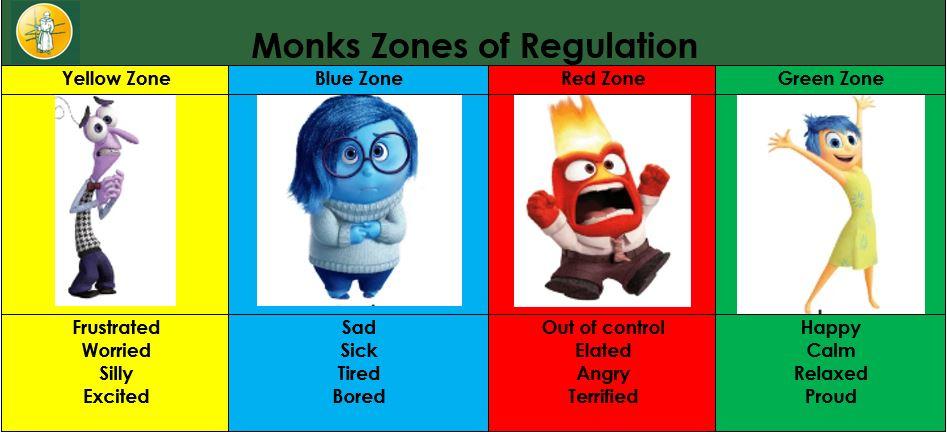
The Zones of Regulation is a curriculum based around the use of four colours to help children self-identify how they’re feeling and categorise it based on colour. The curriculum also helps children better understand their emotions, sensory needs and thinking patterns. The children learn different strategies to cope and manage their emotions based on which colour zone they’re in. Additionally, the Zones of Regulation helps children to recognise their own triggers, learn to read facial expressions, develop problem-solving skills, and become more attuned to how their actions affect other people.
There is progression across the curriculum with children in Early Years learning to identify different emotions to children in Upper Key Stage 2 discussing how our behaviour can impact upon the feelings of those around us.
We aim to help children to:
- Recognise when they are in the different Zones and learn how to change or stay in the Zone they are in.
- Increase their emotional vocabulary so they can explain how they are feeling.
- Recognise when other people are in different Zones, thus developing better empathy.
- Develop an insight into what might make them move into the different Zones.
- Understand that emotions, sensory experiences such as lack of sleep or hunger and their environment might influence which Zone they are in.
- Develop problem-solving skills and resilience
- Identify a range of calming and alerting strategies that support them (known as their personal ‘toolkit’.
We teach the children that everyone experiences all of the Zones. The Red and Yellow zones are not ‘bad’ or ‘naughty’ Zones. All of the Zones are expected at one time or another. We show them that the Blue Zone, for example, is helpful when you are trying to fall asleep.
Find out more about the different zones
How can you help your child use 'The Zones of Regulation' at home?
Identify your own feelings using Zones language in front of your child (e.g.: I’m frustrated. I think I am in the Yellow Zone.”)
- Talk about what tool you will use to be in the appropriate Zone (e.g.: “I need to take four deep breaths to help get me back to the Green Zone.”)
- At times, wonder which Zone your child is in. Or, discuss which Zone a character in a film / book might be in. (e.g.: “You look sleepy. Are you in the Blue Zone?”)
- Engage your child in discussion around Zones when they are in the Red Zone is unlikely to be effective. You need to be discussing the different Zones and tools they can use when they are more regulated / calm.
- Teach your child which tools they can you. (eg: “It’s time for bed. Let’s read a book together in the comfy chair to get you in the Blue Zone.”)
- Regular Check-ins. “How are you feeling now?” and “How can you get back to Green?”
- Modelling It is important to remember to show the children how you use tools to get back to the green zones. You might say “I am going to make myself a cup of tea and do some breathing exercises because I am in the blue zone” and afterwards tell your child how using those tools helped you get back to the green zone.
- Share how their behaviour is affecting your Zone. For example, if they are in the Green Zone, you could comment that their behaviour is also helping you feel happy / go into the Green Zone.
- Put up and reference the Zones visuals and tools in your home.
- Praise and encourage your child when they share which Zone they are in.
Tips for practising the 'Zones of Regulation' as parents
Know yourself and how you react in difficult situations before dealing with your child’s behaviours.
- Know your child’s sensory threshold. We all process sensory information differently and it impacts our reactivity to situations.
- Know your child’s triggers.
- Be consistent in managing your child’s behaviour and use the same language you use at home.
- Empathise with your child and validate what they are feeling.
- Have clear boundaries/routines and always follow through.
- Do not deal with an angry, upset child when you are not yet calm yourself.
- Discuss strategies for the next time when you are in a similar situation.
- Remember to ask your child how their choices made you feel (empathy).
- Praise your child for using strategies. Encourage your child to take a sensory break to help regulate their bodies.
- Create a ‘calm’ box full of things which help to keep your child calm and alert. Advice about what could go in the box can be found on our website in the ‘Zones Toolkit’ section.
Frequently Asked Questions
Can my child be in more than one zone at the same time?
Yes. Your child may feel tired (blue zone) because they did not get enough sleep, and anxious (yellow zone) because they are worried about an activity at school. Listing more than one Zone reflects a good sense of personal feelings and alertness levels.
Should children be punished for being in the RED Zone?
It’s best for children to experience the natural consequences of being in the RED zone. If a child’s actions/choices hurt someone or destroys property, they need to repair the relationship and take responsibility for the mess they create. Once the child has calmed down, use the experience as a learning opportunity to process what the child would do differently next time.
Can you look like one Zone on the outside and feel like you are in another Zone on the inside?
Yes. Many of us “disguise” our Zone to match social expectations. We use the expression “put on a happy face” or mask the emotion so other people will have good thoughts about us. Parents often say that their children “lose it” and goes into the Red Zone as soon as they get home. This is because children are increasing their awareness of their peers and expectations when in the classroom. They make every effort to keep it together at school to stay in the Green Zone. Home is when they feel safe to let it all out.
If you have any other questions, please come email office@monks.org.uk and we will answer the questions and if appropriate add it to the website for other parents too.